Showing posts with label form drawing. Show all posts

Monday, October 01, 2012

Book review: Painting and Drawing in Waldorf Schools


Painting and Drawing in Waldorf Schools: Classes 1-8 by Thomas Wildgruber

This is a book I've been wanting to write a review on for a couple of years.  I first stumbled upon it at the Goetheanum bookstore in Switzerland with my good friend Cari.  One look inside the book and we were both immediately smitten.  It didn't matter that the text was in German or that its purchase price was enough to choke a horse-- we both HAD to have it.

Early this summer it was released in English, and I hemmed and hawed about whether or not I needed a copy of it that I didn't have to translate.  The pre-order price at The Book Depository made it worthwhile though-- a mere pittance compared to what my German copy cost me.  So I winced only slightly before clicking the order button, and I'm so happy that I did, because while most of it is exactly the same, some things and images are different.  Plus, it saves me the time and effort of translating.

Let me repeat myself.  This book is so good that I bought it TWICE.

It's a wonderful guide to every type of painting and drawing experienced within Waldorf education.  Almost every section contains step-by-step guides and thoughtful commentary.  The pictures alone are so inspiring.  This is the book I had wished for when I started homeschooling Sunburst so many years ago and had only the vaguest idea what main lesson artwork should look like.

This is the book we've been waiting for.

Included in this masterpiece are the beginning painting lessons-- the ones that leave most of us homeschoolers with our heads spinning.  It goes on to give a wealth of painting examples for the main lessons in grades 2-5.  As a busy homeschooler teaching three grades, there are not enough hours in the day to do this many paintings.  But I love that they exist.  I love being able to flip though the book and pick and choose a few ideas to bring here and there.  Some ideas I change because that's the nature of art, and others I bring as is because they are just that good.

One major thing this book has done for us is to re-enliven our form drawing.  Form drawing is actually presented very differently in Europe than in the United States.  Okay, I don't know if I can honestly say "all of Europe," but I can definitively say that the main lesson books I saw when I toured the Steiner schools in Switzerland were filled with very colorful form drawings, not much different from the ones in Wildgruber's book.

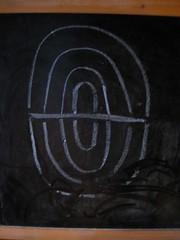
Here's an example from our own form drawing lessons so you can see what I mean.


It's the same drawing, and yet it looks so much more impressive, inviting, and exciting.  Shaded with rich contrasting colors it becomes this palpable thing.  For those of us who were introduced to form drawing as practiced in the states, this is like a free pass.  There is no need to wait for freehand geometry in fifth grade to make form drawing look this beautiful.  And it helps my children to fill in the enclosed spaces so they can really grasp the feeling-- did they create balance?

Other sections of this book that I particularly love for the lower grades are the botany paintings and the drawing section with inspired artwork to display in the classroom.  If only I could draw this well!  The author goes so far as to recommend that children will learn more from our guided drawing examples on paper than from our use of blackboards.  I have noticed this to be true with my own children, and it is so nice to hear someone say this.

For the middle grades, I love that there are several wonderful explorations of light and shadow using different mediums.  And as if the book wasn't already useful enough, the entire section on perspective drawing is priceless.

But you shouldn't take my word for it.  To see all that's on offer here, you should have a look at the Table of Contents which is available as a pdf download HERE.  And then take a look at some of the images included in the book gallery HERE.  (Note, some of these images have been replaced by even better ones in the English translation.)

I absolutely adore this book.  I could go on and on.  There is one series of exercises that Sunburst and I attempted over the summer that really lifted our work in so many ways.  I look forward to sharing some of our drawings with you in the next few days, so I hope you'll come back for that.

Now if only we had a book like this for the high school grades...  Yes, I can dream!

Wednesday, March 03, 2010

Ancient Persia and Forms

Sunburst and I are just now finishing up the study on Ancient Persia. I've notoriously fallen behind on my own schedule. C'est la vie. Lengthy vacations and illnesses will do that to you, and I've made a conscious decision not to feel bad about any of it. Choosing to embrace this moment is as empowering as it gets. Isn't that nice?

Now, for not nice... Can I say for a minute that, pictorially, there's just not much out there for Ancient Persia? Well, I guess I just said it. Really, there's nothing. Maybe Live Ed has something, but I don't have their books. I have pretty much everything else, and I'm telling you, there just isn't much out there to draw from. Maybe the 5th Grade study of Ancient Persia isn't important? That doesn't seem right though. Or fair. I'm all about fair representation.

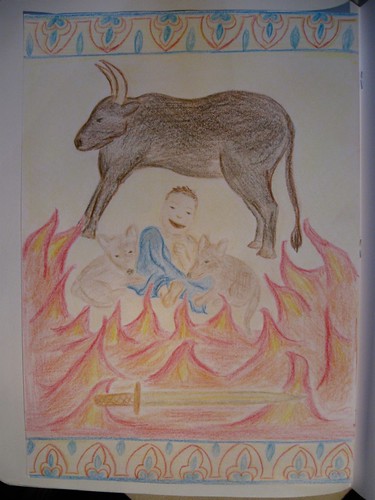
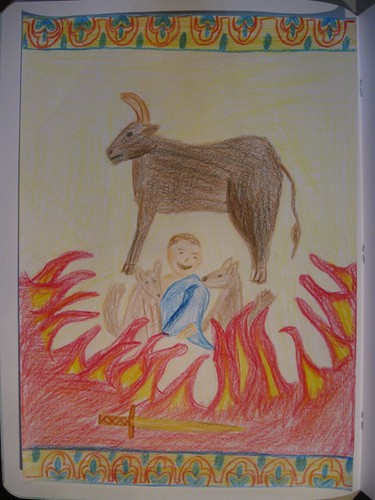
I presented the story of Zarathustra from Kovac's amazing book, Ancient Mythologies, and came up with an idea for a pictorial representation of Zarathustra as a baby being impervious to all the harm King Duransarun tried to do to him. It worked for us.

Mine on the left, Sunburst's on the right:


The form at the top/bottom of the page is modified from a beautiful example on Live Ed's website. It's a pretty difficult form. We have definitely not mastered it yet, either of us, but we decided it was good enough.

We're going to envision another drawing or two this week before we move on to Ancient Babylon/Mesopotamia... which I again have no pictorial resources for. Anyone blogging on that?

----

Meanwhile, Moonshine is back to form drawing-- a few months ago we tried the Clown of God form lesson I created when Sunburst was in Grade 2. But it didn't take then. Moonshine just wasn't ready, wasn't into it. So... now we're trying again. So far, so good.

Tuesday, September 19, 2006

Juggling some new forms

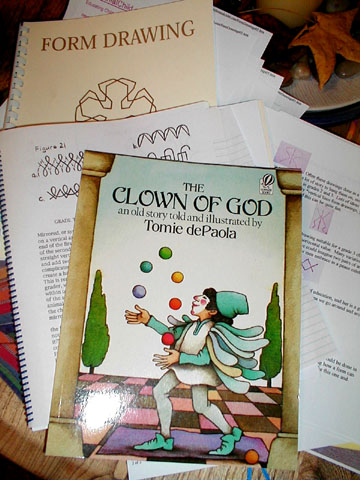
Our school supplies finally arrived, so last night I stayed up long after I should have and finalized my plans for our next lesson. I'm presenting a 3 week block on Form Drawing using the story of The Clown of God. It's a fairly intense story that circles the seasons of one man's, or clown's, life. It touches upon religion and purpose and a sense of something more. It's not a light story, but it seems to fit, and I feel good about it.

Sunburst has never heard this story before. I picked it up on a whim at the bookstore earlier this summer. It spoke to me when I read it and seemed to mirror the spirit world connection that's present in the Saint Stories for Grade 2. The more I looked at it, the more I realized how it was just brimming with forms. And voila!

I read through my pile* of form drawing books and printouts late last night and started sketching the possibilities. I came up with twelve forms that I'm really happy with. My plan is to retell the story in bits as we go along. The ending is really surprising and magical (ok, and kind of freaky,) so I want to leave that for later. The rest of the story is rich enough that it will sustain her as we go along.

I would love to see what forms other Waldorf homeschoolers are covering with their children, so in the spirit of sharing, here are the twelve forms I came up with, roughly sketched/crammed onto the chalkboard. I've tried to incorporate some metamorphosing forms (where you add onto them/change them,) running forms, vertical and horizontal symmetry, lemniscates, growing forms, inward/centering forms, invisible lines, and circles upon circles. A story about juggling really works for all these circular forms!

What's really crazy is how symbolic these forms turned out to be. #1 (top left) is a simple metamorphosing form of a young Giovanni juggling. Though it kind of also looks like a cross emanating rays of light. Our last form, #12 (bottom right) shows a simple lemniscate (numeral 8) and then working a lemniscate inside a lemniscate. It represents the statue of Mary holding the Christ child holding Giovanni's golden ball. But it's also this very solidly infinite thing... and really gives the sense of holding or being held. And yet, it's really not an overly religious story. The only thing that's really in your face is the magic, the mystery, the possibility...

Though you don't have to tell these long, drawn-out stories to do Form Drawing, it's a good idea to make sure the lines on the page represent something tangible that a child can grasp and roll around in their imagination.

The forms I've chosen will represent:
1. Giovanni juggling (Spring)
2. Crowd (young and old)
3. juggling the rainbow balls
4-5. different balls?
6. I think I'll shift this to #11, and make it be the balls rising higher than ever before
7. crowd applauding (Summer)
8. Little Brothers
9. Giovanni old and defeated (Autumn)
10. city scape
11. candle light (Winter)
12. Mary, Christ, and the golden ball

*For those genuinely interested, my pile of Form Drawing Resources includes:
Form Drawing Grades One through Four - Laura Embrey-Stein & Ernst Schuberth
Form Drawing - Hans Niederhauser & Margaret Frohlich
Form Drawing for the Homeschooling Parent - Barbara Dewey
MillenialChild.com - Eugene Schwartz

Form Drawing for Young Children: Grades 1 to 3 - Marsha Johnson (WaldorfHomeEducators)
Journey to Numeria - Alan Whitehead, Spiritual Syllabus

Sunday, September 10, 2006

Making Sidewalk Chalk

I'm getting things ready for our first form drawing block of the 2nd grade year. We like to draw the forms as large as we possibly can outside on our back patio. It's an activity that necessitates A LOT of chalk.

So we make our own.

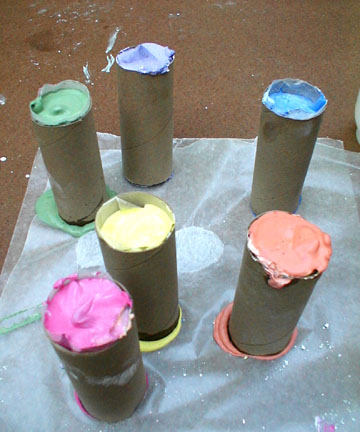
It's really simple. We use plaster of paris, tempera paint, and water. Then we pour our mixtures into toilet paper tubes lined with wax paper. We set our tubes on a FLAT surface (i.e. hardboard) with a double layer of wax paper underneath. You let them sit overnight in the tubes, and then peel them out and let them finish drying. If the weather cooperates, it takes about a day or two for them to fully dry.

The ingredients are really inexpensive. You can find plaster of paris and tempera paint at a craft store. I buy the regular tempera paint, not the washable. And the chalk works great. You can add as much color as you like, so you get really vibrant results.

The original recipe can be found HERE.

Wednesday, September 06, 2006

Back to School...


This is Moonshine's "rainbow leaf." Yes, the autumnal change is upon us. The morning air is crisp and cool, the oaks are scattering their acorns, and a few leaves here and there are slowly turning. I love this time of year!

Last week we stuck to our rhythm fairly easily. We enjoyed the morning walks and the chill they left on our noses and ears. We pass a house on our walk that the girls have taken to calling "the castle." It's a grand house of limestone with two turrets, one on each end. It's really something to behold, especially on a street with fairly normal-looking houses. Some of them are just as large, but turrets? Lion statues poised on the steps? Not even close.

This house has really peaked the girls' interests in castles and what it would be like to live in one. As soon as we return home from the walk Moonshine runs to the costume box and gets princessed-out. More often than not Sunburst has joined in, and they've been queens of their own castle.

While I'm waiting for our shipment of school supplies (and for my grand plan to solidify,) I thought we would keep with the castle theme . We're warming up to the new school year with a few more Grimm's tales and accompanying writing practice. So far, so good. I'm bringing in a few of the "castley" stories that reference God a bit more, since we're going to delve into the stories of the Saints this year, it seemed like a good warm-up to the idea of godliness.

Sunburst isn't too comfortable with the idea of God, actually. Jesus, is easier somehow because there is a human form and baby worship, but God? She can't quite wrap her brain around it, all on her own. I once overheard her at a party debating with a table of mixed-age children about the existence of God and his/her gender. It never occurred to me that children would discuss this topic at length amongst themselves, but there they were... Sunburst adamantly espousing her disbelief and another child declaring that God is a woman. "But God doesn't sound like a girl's name," I heard before I walked away shaking my head and thinking they would get clearer answers from a magic eight ball.

I'm toying with the idea of starting into the second grade lessons with form drawing inspired by the story The Clown of God, told by Tomie dePaola. It has just that spark of the mystery of spirit and miracle that I've been looking for. And touching on our own personal needs, it's a good look at the circle of life, following one clown's life from early childhood to his death, from poverty to fame and back to poverty, and seems to encompass the spectrum of human/animal behavior we'll be covering this year in our readings. It's also a good introduction to St. Francis and the Brothers, which we'll return to in another main lesson. It's brimming with material.

Most of all, I love the passage in the story where Giovanni meets the Little Brothers:


"Our founder, Brother Francis, says that everything sings of the glory of God. Why, even your juggling," said one of the brothers.

"That's well and good for men like you, but I only juggle to make people laugh and applaud," Giovanni said.

"It's the same thing," the brothers said. "If you give happiness to people, you give glory to God as well."

"If you say so," said Giovanni...

I'll stir some nature into the story, plug in some forms, and be set to start when our new supplies arrive. I'm excited, actually. The weather, the story... it feels like I might have wandered back onto the path. In spite of everything. It feels good.

Saturday, July 29, 2006

Why Waldorf?


by Moonshine, age 3
Last night at the park I was talking with a friend about homeschooling, and I was reminded that Form Drawing was really what sold me on the whole shebang of Waldorf homeschooling. I knew Waldorf was lovely, but I vastly underestimated the deeper quality of the lessons. I blindly plunged forward and boy, was I in for a surprise!

I decided to start out simple, and chose our first lesson of Grade One to be Form Drawing. I took it straight out of Barbara Dewey's Form Drawing book. It's a lovely story that includes eight forms, and the more I thought about it, the more I realized how simple and circular the story actually was. We told it as the Autumn leaves were dripping from the trees, and it was perfect.

The lesson starts out with a curved and straight line that represents an old grandmother and her walking stick: Cl

I was worried that it would appear too simple for Sunburst, but she loved it. I told her the story and showed her the form, and she lit up inside. She was eager and excited and bursting with joy about it. I didn't fully understand why she was so moved by this simple form, but we pressed on. We worked the form in the air with our hands and on the floor with our feet. Sunburst practiced it on the chalkboard with water and chalk, on scrap paper, and finally drew it on good paper. It didn't present too much difficulty. She was positively glowing.

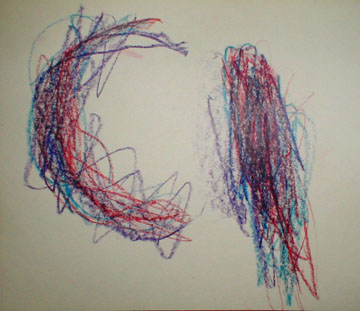
Moonshine, who was three at the time, listened in on the lesson. While I was busy with Sunburst, Moonshine got out her own paper and set to work out of my sight. She made her own grandmother-- a multicolored, layered, and scratchy rendition of it that stopped me in my tracks. It was a deep, powerful image that left me speechless.


The next form represented the three blue-eyed granddaughters: lll

Easy, right? That's what I thought until I presented it to Sunburst. She took one look at the form and just crumpled. Her glowing light vanished. She tried to do it, but she couldn't. The three straight lines defeated her, and I just didn't get it. I thought it was easy, maybe even too easy. Even Moonshine could do it.

It was just straight lines. I wasn't asking her to make a copy of a Renoir, just to make lines. Three of them, parallel and stairstepped. And try as she might, in the air, on the floor, on the chalkboard, she just couldn't manage it. I was dumbfounded. What was going on here?

Sunburst is incredbly determined. She taught herself how to pump her legs on the swings at age 3, ride a bike without training wheels at age 4, turn cartwheels at age 5, and do front-handsprings and read the summer after she turned six. She's also fearless and fast. She thinks she's Susan, the cheetah, and runs FAST on four legs. She really does, and it's confounding to watch. It's her preferred mode of transportation.

I truly believe she can do anything she sets her mind to, but this particular drawing seemed to have stumped her. Her shoulders sagged and the light went out of her eyes. I was ready to scrap the whole idea of Waldorf homeschooling seeing her so completely unhappy, defeated, and out of her element. But I didn't. I let it sit with me for a day before I realized what had happened. I had presented the granddaughters as having blue-eyes, like Sunburst, thinking she would connect with them. But she didn't. What I failed to realize is that I had presented them as upright human beings, two-legged creatures, straight lines. Sunburst is NOT a straight line. She could not identify.

There's something to this Waldorf stuff.

I thought we were drawing shapes and telling lovely stories, and yet it seemed we were doing something so much deeper than that. Sunburst took that form to sleep with her, in a figurative sense, and emerged a few days later able to draw it. It had to work through her somehow, come to terms within her. The whole experience just blew me away. We were doing so much more than drawing forms here...
***

To read more about Form Drawing, I suggest visiting David Darcy, Kytka's site, and as always, Wonder Homeschool.

Rebecca, another Waldorf homeschooler, recently had her own moving experience with drawing forms. I've been thinking about her post all week, as it has reminded me that while I think I'm just teaching my children, I shouldn't underestimate the deeper work that is happening within myself.

Wednesday, May 10, 2006

My Life with Aliens


Yesterday we talked about the Big Zero. Minus, our resident math gnome, counted the cups of water that spilled from his bucket onto the sides of the path. It wasn't long before his bucket was empty and we were left with a sum of zero. It was a story about subtracting, but also one of giving, for you see Minus had sprinkled some flower seeds along the sides of the path and had chosen to give them life. We do that every day, don't we? We subtract. We give so that new things may come to life. When we hit the Big Zero, the possibilities are limitless.

Today was all about subtraction. Kitty Bill was cutting teeth, and so I gave. The phone kept ringing, so I gave. Sunburst inadvertently ripped the dishwasher out of the wall, and I gave. I subtracted the available minutes of my time and managed to only present the next form in our story of Robin Red: a spiral. In the story, Robin goes to the forest in search of Mother Earth and meets the messenger snail, ergo our spiral form emerged.

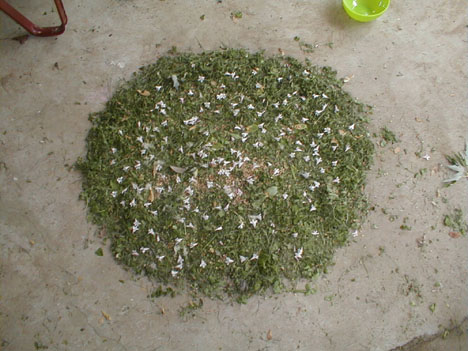
The girls then wisely subtracted themselves from the house and played outside for a good chunk of time. I went out to check on them at one point and found that Sunburst had been practicing making chalk spirals on the patio. Ten feet from that was a near perfect circle, sculpted of collected lawn clippings, and carefully decorated with birdseed and flowers.

A crop circle?

"A nest," explained Sunburst.

In Waldorf circles (ha) people talk much about letting a lesson sleep. It's precisely this way that new forms are conquered, new skills are mastered, and so forth. Sometimes we find lessons that we have to let steep for days within our subconscious. I know certain lessons I've been steeping for decades, and still haven't mastered inside myself. But I always forget the power of this sleeping/steeping process, and I'm often startled and amazed by the leaps and transformations these kids make, as if aliens have been visiting them in the night and sharing the secrets of the universe.

The big zero came back, during a time of zero expectations, as nature art. Making something out of nothing. Zero.

And the spirals? At dinner it occurred to me that it's the same; you start with nothing, a center, a zero, and you go outwards in such a limitless fashion. With zero we talked about meditation, a familiar concept in our house, in which the point is to get back to nothing. To let all the outward forces go and return to the center of spirit, the beating of your own heart.

Using the spiral last night, a spontaneous story of Clara came up. Clara, our good story companion, had a time when she was completely overwhelmed, such that she couldn't function. She's a wiseman's daughter and slated to take his place someday, and so of course she took that overwhelmed feeling and just sat with it. She closed her eyes and breathed, and we watched the spiral fold in as her cares washed away and when she reached the center she was still and calm and able to handle anything that came her way. At which point, Sunburst closed her eyes, and began to meditate.

Sometimes I wonder who's teaching who here. I think this one was a lesson for me.


*** Mood music brought to you by Dusty Springfield: ***

"Round; Like a circle in a spiral; Like a wheel within a wheel
Never ending or beginning;
On an ever-spinning reel..."

"Like the circles that you find; In the windmills of your mind"

Tuesday, May 09, 2006

I am Robin Red


Sunburst has been learning to play the pentatonic flute since February. I've been using David Darcy's booklet/cd set Playing the Pentatonic Flute and the Pentatonic Recorder to teach myself so that I can teach her. I can't say enough wonderful things about this booklet. It has changed the way I think about music and my own musical capabilities.

For instance, I now think capable as opposed to incapable. I live with Einstein who is a musical genius. He can, and does, play anything he can get his hands on. But he can't teach me... he's my husband after all, and I have this Complex about music. Or shall I say had. I no longer play secretively in the laundry room. David Darcy has brought me into the light.

And now I can give that to Sunburst.

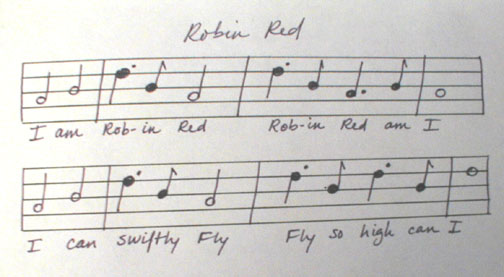
Our second form drawing block was based on a story I made up about the adventures of Robin Red and his search for Spring. With that in mind, I found myself being challenged to write a song of my own for Sunburst to play on the pentatonic flute: Robin Red. It's simple-- using only the notes A, B, and D. But simple is key, I think. It met her where she was, connected to her heart, and took her playing up a notch.
She struggled with it for a couple of weeks, but after her experience meeting a Native American flute player, she returned to this song with renewed vigor and quickly mastered it. Her own musical confidence grew by leaps and bounds with this song, as if she's now swiftly flying along, too.

Related Posts with Thumbnails
 
Site Meter