Showing posts with label Grade 4. Show all posts

Monday, October 01, 2012

Book review: Painting and Drawing in Waldorf Schools


Painting and Drawing in Waldorf Schools: Classes 1-8 by Thomas Wildgruber

This is a book I've been wanting to write a review on for a couple of years.  I first stumbled upon it at the Goetheanum bookstore in Switzerland with my good friend Cari.  One look inside the book and we were both immediately smitten.  It didn't matter that the text was in German or that its purchase price was enough to choke a horse-- we both HAD to have it.

Early this summer it was released in English, and I hemmed and hawed about whether or not I needed a copy of it that I didn't have to translate.  The pre-order price at The Book Depository made it worthwhile though-- a mere pittance compared to what my German copy cost me.  So I winced only slightly before clicking the order button, and I'm so happy that I did, because while most of it is exactly the same, some things and images are different.  Plus, it saves me the time and effort of translating.

Let me repeat myself.  This book is so good that I bought it TWICE.

It's a wonderful guide to every type of painting and drawing experienced within Waldorf education.  Almost every section contains step-by-step guides and thoughtful commentary.  The pictures alone are so inspiring.  This is the book I had wished for when I started homeschooling Sunburst so many years ago and had only the vaguest idea what main lesson artwork should look like.

This is the book we've been waiting for.

Included in this masterpiece are the beginning painting lessons-- the ones that leave most of us homeschoolers with our heads spinning.  It goes on to give a wealth of painting examples for the main lessons in grades 2-5.  As a busy homeschooler teaching three grades, there are not enough hours in the day to do this many paintings.  But I love that they exist.  I love being able to flip though the book and pick and choose a few ideas to bring here and there.  Some ideas I change because that's the nature of art, and others I bring as is because they are just that good.

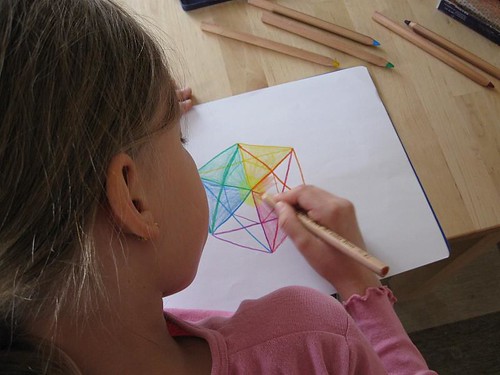
One major thing this book has done for us is to re-enliven our form drawing.  Form drawing is actually presented very differently in Europe than in the United States.  Okay, I don't know if I can honestly say "all of Europe," but I can definitively say that the main lesson books I saw when I toured the Steiner schools in Switzerland were filled with very colorful form drawings, not much different from the ones in Wildgruber's book.

Here's an example from our own form drawing lessons so you can see what I mean.


It's the same drawing, and yet it looks so much more impressive, inviting, and exciting.  Shaded with rich contrasting colors it becomes this palpable thing.  For those of us who were introduced to form drawing as practiced in the states, this is like a free pass.  There is no need to wait for freehand geometry in fifth grade to make form drawing look this beautiful.  And it helps my children to fill in the enclosed spaces so they can really grasp the feeling-- did they create balance?

Other sections of this book that I particularly love for the lower grades are the botany paintings and the drawing section with inspired artwork to display in the classroom.  If only I could draw this well!  The author goes so far as to recommend that children will learn more from our guided drawing examples on paper than from our use of blackboards.  I have noticed this to be true with my own children, and it is so nice to hear someone say this.

For the middle grades, I love that there are several wonderful explorations of light and shadow using different mediums.  And as if the book wasn't already useful enough, the entire section on perspective drawing is priceless.

But you shouldn't take my word for it.  To see all that's on offer here, you should have a look at the Table of Contents which is available as a pdf download HERE.  And then take a look at some of the images included in the book gallery HERE.  (Note, some of these images have been replaced by even better ones in the English translation.)

I absolutely adore this book.  I could go on and on.  There is one series of exercises that Sunburst and I attempted over the summer that really lifted our work in so many ways.  I look forward to sharing some of our drawings with you in the next few days, so I hope you'll come back for that.

Now if only we had a book like this for the high school grades...  Yes, I can dream!

Wednesday, May 30, 2012

St. George's play


At the end of April we had St. George's Day here in England.  Apparently it's a big deal.  Since we were in the midst of a local geography lesson, it seemed only right to learn more about it and how it's celebrated here.

We already knew the story of St. George slaying the dragon.  It has been told and retold countless times, by countless people.  Usually it's something we do at Michaelmas, and my go-to version comes from one of the Waldorf books.  However, this time I told a version I found over at the Baldwin Project from C. S. Bailey, entitled simply: St. George and the Dragon.  And the girls were quick to say that they preferred this retelling much more than the others.

Because Sunburst had been studying the Crusades a few months ago, we were reminded about how St. George's cross was used to identify a crusader and then brought to England by Richard the Lionheart to identify English troops in battle.

We set out to hear the poem by William Blake ("And did those feet in ancient time") that was turned into a hymn of sorts and named "Jerusalem."  It's a wonderful song-- even Emerson, Lake and Palmer covered it in the 70s.  The girls were so enamored with the song that we were inspired to learn it.  And that was Monday.  Our first attempts to get the tune down were hilarious, but by Tuesday we had begun to show signs of improvement.


The girls both made some lovely St. George drawings for their books.  Sunburst wanted to draw hers in pencil, while Moonshine asked if she could use pastels.  Moonshine's drawing had such an otherworldly quality to it that it reminded me of program covers from Waldorf school plays.  The more I thought about it, the more convinced I was that we finally had a large enough cast to put on a proper play.  The kids were immediately excited by the idea and thought it would be a great surprise for their dad Einstein.


We created a program using artwork from the girls' main lesson books.  I included the words to "Jerusalem" so that it would be a nice keepsake for the kids.  Even Kitty Bill picked up the lyrics rather quickly.

 Here is Sunburst's drawing on the inside of the program:


And Kitty Bill was inspired to draw a picture, as well: 


Both Sunburst and Moonshine wanted to help write the dialog, so we worked on it together in the afternoons as they found the inspiration.  Somehow the entire thing took on a life of its own and turned into a musical-- this is what happens when you have children that don't ever stop singing.

Sunburst played both the king and the dragon.  She managed to transform a cereal box into a convincing dragon's head.  Moonshine took the part of the Princess Sabra, with the comic exception that she wanted to be eaten by the dragon.  Kitty Bill played St. George.  His role was fairly straight forward, but he managed to bring some comedic personality to the role when, overcome with wonder by Sunburst's convincing dragon death scene during rehearsals, he shouted, "Awesome!"  We laughed so hard that we decided to leave that line in for the performance.

They had a fantastic time, and Einstein was completely impressed.  He couldn't believe that they had pulled off the show without him catching any hint of it.  And of course he was taken with their performances.

We managed to capture the entire performance on video to send the grandparents back in the states.  I think it will be quite the treat for my British grandmother in particular.  I fully expect she will be singing along.

Thursday, March 29, 2012

Snails


Moonshine and I have been working on some human and animal studies this month.  Right now we're having fun with snails... it took us quite a bit of poking around to find some that the birds hadn't already eaten in our garden.  Every morning there is a scattering of broken shells all over the place.  The birds must be having quite an early morning feast.  If I were a snail, I would be hiding, too!
One thing I could thank the birds for was that they made it quite easy to examine the inner spiral of the shells.  So perfect!  They reminded us of a spiral ceiling we saw in Barcelona this past summer.

After digging around a bit in the garden, we unearthed a couple of live snails to investigate.  Then we made good with some empty shells and modeling beeswax to make some snails for the nature table.  Moonshine was so pleased with how they came out -- a mama and a baby!  So precious together!


Moonshine was hungering for some lovely stories this week, so we read the snail stories included in Jacob Streit's Animal Stories.  I've been looking for a copy of this in English for years, and I finally found one a couple of months ago.  It would have been perfect for Grade 2, but we're happy to have it at all.  I think it's just as applicable to the Grade 4 study anyway.  Perhaps I chanced upon our copy at the right time after all.


Just by luck I came across an interesting BBC video about the sounds tiny insects make, including snails.  Fascinating stuff!

Moonshine and I have also been talking about crafting some animals for our study.  I found the cutest pattern for crocheted snails here.  At first glance it looks to be a bit complex for my mediocre crocheting skills, so we may just end up making it up.  I'm thinking it will be fun to try.

But not this week.  This week I have undertaken a HUGE project which is eating up all of my extra bits of time.  Not that I have many extra bits, but you know what I mean.  Hopefully, I'll be able to show you that huge undertaking tomorrow.

Wednesday, March 21, 2012

Norse Myths


Moonshine has been thoroughly enjoying the Norse myths, and it really shows in her work.  She has become such a wonderful artist-- quite attentive to detail and completely absorbed in what she's doing.  Her enthusiasm is delightful.

It's my second time introducing a child to these wonderful stories, and this time around I'm pulling ideas from two additional sources-- Charles Kovacs' Norse Mythology and Eugene Schwartz's Grade 4 files-- as well as D'Aulaire's Norse Myths.  When I did this block with Sunburst so many, many moons ago, I just had the latter book to pull from, and it was fine.

This is not the first time that I'm left wondering if too many sources is a bad thing.  The Kovacs' book was just released in the last couple of years, and because I've grown quite fond of his work, I was eager to buy it.  Twice, as it turned out, because I inadvertently loaned out my first copy.  Anyway, so far it's a lovely book.  Both the Kovacs' and D'Aulaire's have engaging stories.  Visually though, the D'Aulaire's is incomparable.

There are discrepancies between the two re-tellings-- different names, different outcomes, and a different order to the stories.  Some characters are highlighted more in each source, which is neither good nor bad, just an observation.  I will probably continue forward with both books when we return to finish up next month.

The files from Eugene Schwartz have some good phrasing with the writing examples.  Moonshine wants to tell every part of the story in her writing, and I found the beginning a good compromise with some of his phrasing and some of our own.  Moonshine was smitten with the beginning of the Kovacs' story, so we borrowed his poetic introduction as well.  We're also borrowing ideas from Sunburst's main lesson book when it feels right.  It seems like that was created a lifetime ago... has it only been three years?

Both Moonshine and I were completely surprised with the quality of her work this time around.  There has definitely been a palpable shift.


We're having a bit of an issue with the quality of the latest batch of main lesson books that I ordered.  The ink from the fountain pen runs right though!  We've ended up doing a lot of pasting into our books.  As you can see below, it looks like she forgot to make a background and paste one in.   Oops.

When she's done with this block, I plan to have her go back to these images and work in some celtic knot form drawings where she can fit them in.


Sunburst would like me to point out that the following is a poem that she and I wrote together when she did this lesson.  Moonshine liked it so much that she asked to copy it into her own book.  Except for the opening pages, the rest of the writing was created from Moonshine's verbal retelling of the stories, and then me telling her, "It's too long, how can we make it short enough to fit in your book?"


Saturday, October 24, 2009

Everything cows!


We're still finishing up our zoology book from last year. Now that we're practically living on a farm, it makes it a much easier task.

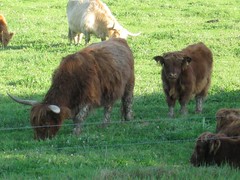
From our studies of Ancient India to the lowing out in the fields, everything is suddenly turning up cows!


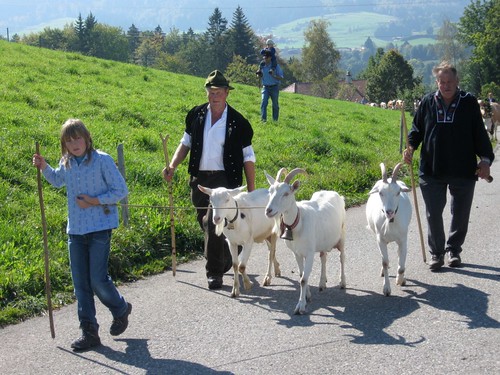
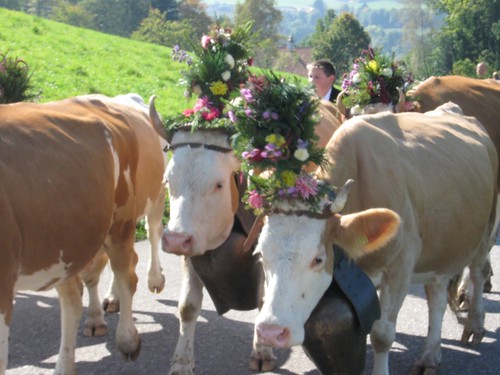
Our weekend trip to the Swiss mountainous countryside coincided with the Swiss cows coming down from the mountains for the winter. Apparently the goats came with them.


These cows are currently pasturing behind our house, and the girls have been making daily visits to a newborn calf in the stable next to us.


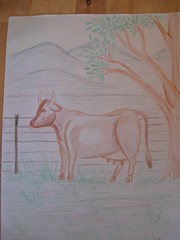
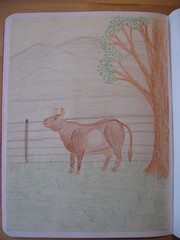
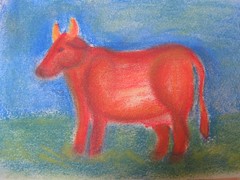
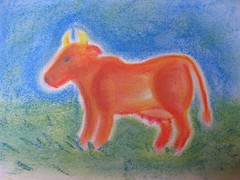
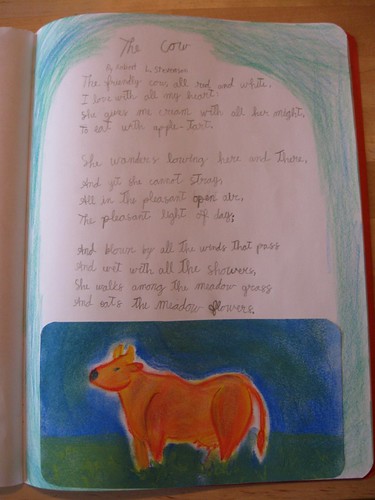
Since we don't eat cow, we celebrated our appreciation for them with some artwork (mine and Sunburst's):


My attempts at pastel cows:


and Sunburst's, including a poem she memorized awhile back:

Friday, February 27, 2009

Worms, math, and treehouses

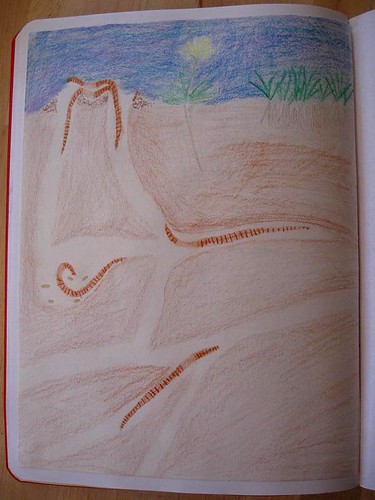
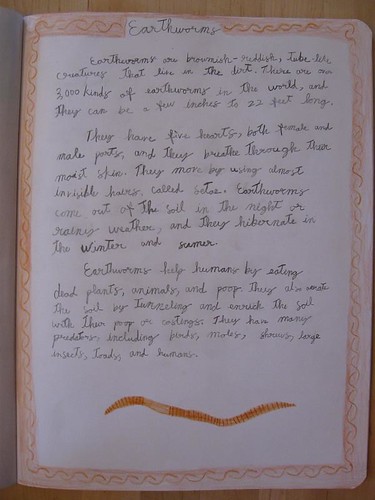
Busy week! This week I presented the earthworm, straight out of Klocek's book, Drawing from the Book of Nature. It's still much too cold to go digging for actual worms here, but as avid gardeners, we're no strangers to the amazing, little creatures.


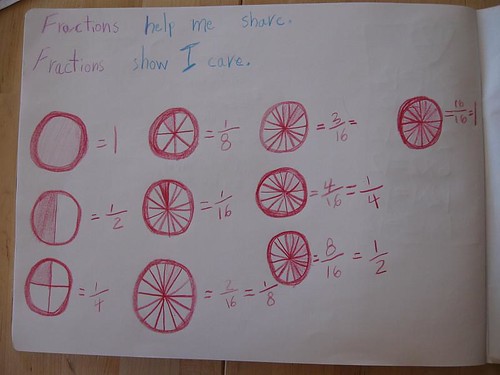
Worms segued very easily into a lesson on fractions when we read that if you cut them in half, they die. But if you only cut off the the hind third, they don't die. Sunburst has been hungry for new math problems, and instead of waiting to present this as a block, I just jumped right in with some ideas from Dorothy Harrar's math book.

Sunburst told me she hated fractions, so we started out with some sentences about fractions being good things and a story illustrating the truth of those sentences: Sunburst gets on the bus with an apple. Her hungry friends get on the bus, and the apple gets shared and cut each turn, until eventually there are sixteen slices - one for each child. Last to get on the bus is an old man who is starving. The kids all decide to share their slices with this old man, so that in the end, he has the entire apple.


And then we did some very simple fraction work to build the foundation.


I also backtracked through Dorothy Harrar's math book and brought forth a lesson from the second grade section-- it seemed more like a fractions story than a multiplication story.


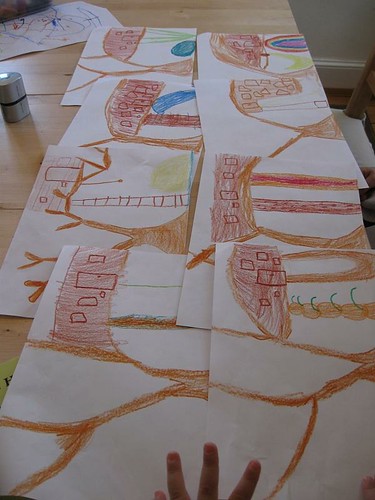
Moonshine did a little math herself, sort of. While Sunburst was busy at work on her fractions tree, Moonshine wanted to draw a little tree of her own. This tree multiplied itself into a dozen treehouses, each one designed with specific friends in mind. When Moonshine gets an idea there is no stopping her.


And what of Kitty Bill? He got in on the drawing fun, too. Sometimes he likes to do that. Other times, like today, he just steals off with a pair of scissors and cuts everything in sight. Of course we prefer it when he draws pictures instead.

Related Posts with Thumbnails
 
Site Meter