Showing posts with label Grade 1. Show all posts

Wednesday, March 27, 2013

One, the Sun! (part 2)

A couple of months ago I posted the first half of our Quality of Numbers main lesson.  I honestly didn't mean to leave off on posting the second half for so long, but life had other plans.  Apologies to anyone who was worried that those kids would never get out of the enchanted tunnel.  I hope it hasn't kept you up at night. ;)

If you find yourself wondering what the heck I'm talking about, please see part one of this story here: "One, the Sun!"

For those of you who wishing I would just get on with it, I will try to keep it short and sweet-- just like tunnel number six, which was....


6 - a drop down into a deep room filled with huge crystals... OR a beehive loaded down with honey (the sound of buzzing is a nice effect).  I did the crystal story with Sunburst, and her characters had to actually stack up the crystals to climb out.  Luckily, they were able to carry just one back to the dragon. With Moonshine and Kitty Bill, the treasure was a bit of honeycomb, and we were mesmerized by the perfect six-sided forms.


7 - this tunnel leads out to the afternoon sky where the rainstorm is ending.  And of course they see a the most glorious rainbow.


8 - a spider web with a spider.  This one landed on the prince's head!  My son laughed so hard he fell out of his chair.


9 - they meet a fox who had previously stolen the dragon's 3 golden scales.  If they can answer a riddle, he will return the golden scales.  If not, well... they must agree to lead him out of the cave and he keeps the scales.  I used "When I was going to St. Ives..." and changed the central number in the riddle from seven to nine. We drew three golden triangles (dragon scales) and noticed that there are not only nine points, but nine lines as well.


10 - they find fireflies, but this poses a problem, for without jars how will they catch ten?  Or do they need to catch ten?  ---With a bit of make believe firefly catching, we come to the stunning realization that it is the child's hands which holds the treasure of ten.


Now this is where the Quality of Numbers lesson gets a bit fuzzy, because not one of the resources I have ever encountered mentions any suggestions for the number eleven.  Like the last day of creation in the Grade 3 Creation study, the number eleven gets no mention.


11 - When I first tried teaching this block, I tried to stay in the natural world for number eleven.  I couldn't think of anything, so I settled in with a suggestion from my good friend Moxy Jane to use moonbeams.  That worked okay for Sunburst, but by the time I taught Moonshine, I had realized there wasn't a wrong answer for this number.  Eleven is simply ten plus one more, and it doesn't matter what you're counting.  So you might as well make it fun!

For Moonshine's story, at the end of the eleventh tunnel there was an eleven-piece matryoshka doll (for a girl who has a VERY soft spot for nesting dolls, this was a real treat).  And for Kitty Bill, who has been developing a new interest in all things dinosaur, there was a shovel and the boys dug up eleven dinosaur bone segments.  (Yes, segments, because as you and I know, eleven bones does not a skeleton make.)  He was thrilled, both by the story and by the drawing.

If you're still struggling with the number eleven, Eva of Untrodden Paths has contributed some wonderful suggestions:
"For number eleven: I used Joseph's dream of the eleven sheaves of corn bowing to him. You could also use the eleven stars bowing down to Joseph in his second dream.  For another, more grade one-like, idea: H.C. Andersen wrote a fairy-tale called "The Wild Swans," which is about eleven swans (eleven brothers). That would be perfect I think!"

And finally... 12.


There are a few different things people use for the number twelve-- a clock, a dozen eggs, the Twelve Dancing Princesses... They all felt like such an anti-climax for me.  I wanted to end the story with something marvelous, and in my exhaustive search I found a very strange video that spoke to me.  I called it further proof that inspired story ideas can come from anywhere, including marketing videos designed by internet marketing firms.  Who knew?!

http://web.twelvehorses.com/swf/legend.html


12 - this tunnel opened up directly upon a field of twelve horses all under an enchantment.  As this was the final tunnel, it was our most outrageous story.  The story characters had to figure out A. why aren't the horses responding?, and B. how to break the enchantment.  It was a favorite with both the girls and Kitty Bill, and it really spoke to them deeply.

I borrowed the above "legend" and the horse constellation for our "twelve" picture, but in my version of the story the chariot belonged to the Sky Queen.  The adult in this story remembered the legend and shared it with the kids, who exclaimed, "These must be the horses!!"  But how do we break the enchantment and bring them back to the dragon?

The characters in the story tried many things-- as many things as my children could think of to "wake up" the horses... yelling, whispering, sitting on them, pinching them, tickling them, kicking them... it went on and on, until finally, they sat to ponder the problem over lunch.  The main character took out his handwork, and as he worked, he began to hum.  A horse twitched!  The other characters noticed, and after much guesswork, they began to put the clues together.  There was a lot of humming, but this only produced twitches from the horses... curious!  Finally, with much guesswork on behalf of both the characters and my child, our main character decided to sing from his heart.


"Ponies, now ponies, don't you worry.
I'm not here to steal your fire away.
I want to fly with you across the sunrise.
And remember what begins each shining day."
--the chorus from "Ponies" by Michael Martin Murphy.

As the character sang to each horse, it awoke from the enchantment.  Each time we sang, it was louder and bolder, until we were bursting with song.  The pure delight and joy on each of my children's faces, on the separate occasions they heard this story, was priceless.  
It touched something deep in their hearts and souls that I can't even begin to put my finger on.  But these moments?  That's what homeschooling is about!


After the enchantment was broken, the dragon came soaring out of the cave to thank and congratulate them.  The Sky Queen, in all her radiance, appeared before the story characters.  She thanked them dearly, and presented the story child who first broke the enchantment with a special gift... a flute made from the magic pear tree.  This was the GREATEST GIFT (as the video legend says and thus interpreted by me) --giving them the means with which to communicate without words and with nature itself.  Music is its own kind of magic, after all.


At the end of this lesson, I presented my child his/her very own flute made from the magic pear tree --the quinta Choroi pentatonic flute.  It's with this flute that, at the end of the alphabet lesson, our characters can call an animal friend for a lift home-- for Sunburst and Kitty Bill it was the dragon itself, and for Moonshine it was a great white bird.

This was another one of these moments that no words can adequately describe, but I feel like presenting them with their very own flute in this way gave them a heightened reverence for it.  Music touches us so deeply, both man and beast, and I wanted them to start out on that footing.  This is a special way of communicating.  Guard it wisely.  Honor, revere, and develop it.  And know that music is a sacred gift.

Of course this was the end of our first mathematics story, which was really just a story inside another story.  Filled with joy and happiness, we then continued on with the original alphabet journey which culminates in a cheerful, happy ending.

Afterwards, the flute accompanies us as we work our way into another form drawing block and on into another maths lesson.


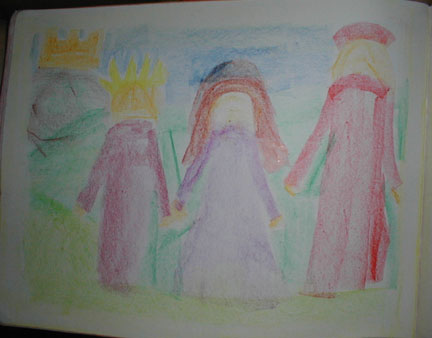
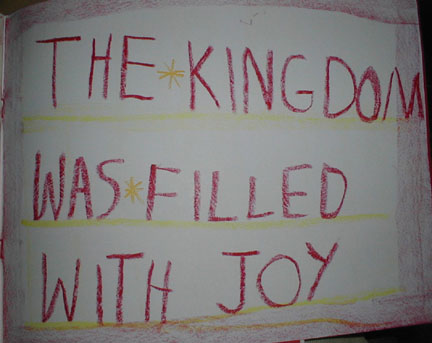
As for the last few drawings above, I left those completely up to my children to work on independently.  Funnily enough, they each chose to draw the horses, the Sky Queen, and the dragon.  These are all Kitty Bill's drawings and text.  I am completely charmed by his red dragon, golden scales and all.


Tuesday, November 27, 2012

One, the Sun!

One, the sun!

The Quality of Numbers main lesson block is perhaps my most favorite part of teaching Grade One.  As for Kitty Bill, I think it's his favorite homeschooling lesson yet.

I know I've shared a bit about my alphabet story in the past, but I don't know that I've ever shared my story for the Quality of Numbers main lesson.  I wrote the basic idea out for a friend a few years ago.  Like everything else, it changes each time I teach it, but it's nice to have it written down to refer back to for story ideas.  And as far as stories go, this one is pretty wild.

For starters, there is an enchanted cave that can only be opened by solving riddles.  I borrowed the opening idea and the riddles from Eric Fairman's Pathway to Discovery (Grade One).  Inside the cave is a dragon, but luckily it's a friendly dragon who is under an enchantment.  He can't fly or leave the cave until someone solves the riddle of the twelve tunnels.

Since it's a continuation of our alphabet story, our three traveling characters are up for any adventure.  To help the dragon break the enchantment, our travelers must explore the twelve passages in the cave and bring back "treasure" from each one.  Each journey into a particular passage is fraught with interesting discoveries... passages that wind in circles or fork into separate directions.  Sometimes they are very dark or smelly or impossibly small.  Sometimes only the main character, the one my child identifies with the most, is the only one who can fit in a certain passage.  I vary it widely to keep it interesting and entertaining, because above all, I want math to start out as being a grand, entertaining adventure.

As we journey together we discover something at the end of each tunnel.  I then enlist my child's help in working out what the treasure is (and what it signifies) based on what the characters find, and they make suggestions as how to "capture" the treasure to bring it back to the dragon.  My one caveat was the treasure MUST correspond with the number of the tunnel.  Naturally, we converse about what each number signifies and we look to find other representations of each number in the world around us.  Sometimes these representations come out within the story itself, and other times I ask the question, "What else can you think of?"  It really helps us embody the spirit of each number and its place in the world.  When we make a relationship with the numbers they become truths that live inside of us.

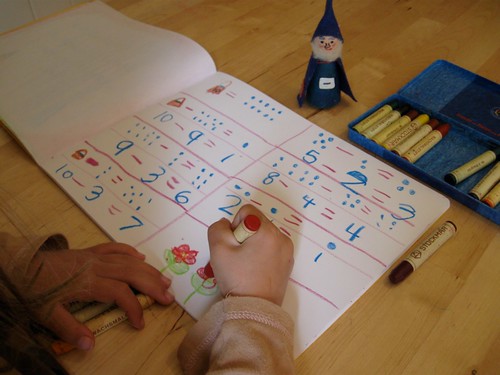
With each discovery we draw two pages in the main lesson book.  We draw the treasure in each tunnel, and then we draw the number-- with straight lines or sticks (Roman numerals) and then in Arabic numerals.  We spend a bit of time practicing to make sure we get the numbers right.


Kitty Bill knows that as we travel down each tunnel that leads away from the dragon, we're looking for something that embodies the number of the tunnel.  The beauty of this block is that it grounds the number in whatever is found, and thus gives the number a picture quality that brings it to life.

Here's what our characters found in the tunnels:
1 - The sun reflected in a pool of water  (One, the Sun!)

2 - Nothing! .... but ah, upon closer inspection there is a reflection of the two child characters, who began the adventure as extreme opposites and have grown into friends... (Two, Me and You!)

Two, me and you!

3 - A pile of garbage (which is always good for a laugh!)... an old shoe, a holey mitten, something unrecognizable and gooey.... and eventually a picture of a mother, father, and baby (Three, Family)


Three, family!

4 - At the end of a very dark tunnel, high above on a ledge... something icy, wet and cold; something soft and sweetly scented; something dry and crumbly; something small, round and juicy OR small and smooth with a bit of grit inside.  This one is a bit tricky depending on the child.  Kitty Bill wasn't quite sure, so I sent his characters falling through a trapdoor where they landed in the snow and had a snowball fight.  When they got too cold, they made their way out of this new tunnel where the temperature kept changing, as did what was under their feet.  Eventually he figured it out.  (Seasons Four)


Four Seasons

5 - This tunnel leads out to the night sky, filled with stars - they can't bring a star back, but finally one character realizes he/she has five points like a star.


Kitty Bill can't wait to find out what's in the next tunnel.  What about you?

If you would like to hear the rest of the story, be sure to leave me a comment.  If enough people are interested I will post the rest of the story as we go along.


Monday, October 01, 2012

Book review: Painting and Drawing in Waldorf Schools


Painting and Drawing in Waldorf Schools: Classes 1-8 by Thomas Wildgruber

This is a book I've been wanting to write a review on for a couple of years.  I first stumbled upon it at the Goetheanum bookstore in Switzerland with my good friend Cari.  One look inside the book and we were both immediately smitten.  It didn't matter that the text was in German or that its purchase price was enough to choke a horse-- we both HAD to have it.

Early this summer it was released in English, and I hemmed and hawed about whether or not I needed a copy of it that I didn't have to translate.  The pre-order price at The Book Depository made it worthwhile though-- a mere pittance compared to what my German copy cost me.  So I winced only slightly before clicking the order button, and I'm so happy that I did, because while most of it is exactly the same, some things and images are different.  Plus, it saves me the time and effort of translating.

Let me repeat myself.  This book is so good that I bought it TWICE.

It's a wonderful guide to every type of painting and drawing experienced within Waldorf education.  Almost every section contains step-by-step guides and thoughtful commentary.  The pictures alone are so inspiring.  This is the book I had wished for when I started homeschooling Sunburst so many years ago and had only the vaguest idea what main lesson artwork should look like.

This is the book we've been waiting for.

Included in this masterpiece are the beginning painting lessons-- the ones that leave most of us homeschoolers with our heads spinning.  It goes on to give a wealth of painting examples for the main lessons in grades 2-5.  As a busy homeschooler teaching three grades, there are not enough hours in the day to do this many paintings.  But I love that they exist.  I love being able to flip though the book and pick and choose a few ideas to bring here and there.  Some ideas I change because that's the nature of art, and others I bring as is because they are just that good.

One major thing this book has done for us is to re-enliven our form drawing.  Form drawing is actually presented very differently in Europe than in the United States.  Okay, I don't know if I can honestly say "all of Europe," but I can definitively say that the main lesson books I saw when I toured the Steiner schools in Switzerland were filled with very colorful form drawings, not much different from the ones in Wildgruber's book.

Here's an example from our own form drawing lessons so you can see what I mean.


It's the same drawing, and yet it looks so much more impressive, inviting, and exciting.  Shaded with rich contrasting colors it becomes this palpable thing.  For those of us who were introduced to form drawing as practiced in the states, this is like a free pass.  There is no need to wait for freehand geometry in fifth grade to make form drawing look this beautiful.  And it helps my children to fill in the enclosed spaces so they can really grasp the feeling-- did they create balance?

Other sections of this book that I particularly love for the lower grades are the botany paintings and the drawing section with inspired artwork to display in the classroom.  If only I could draw this well!  The author goes so far as to recommend that children will learn more from our guided drawing examples on paper than from our use of blackboards.  I have noticed this to be true with my own children, and it is so nice to hear someone say this.

For the middle grades, I love that there are several wonderful explorations of light and shadow using different mediums.  And as if the book wasn't already useful enough, the entire section on perspective drawing is priceless.

But you shouldn't take my word for it.  To see all that's on offer here, you should have a look at the Table of Contents which is available as a pdf download HERE.  And then take a look at some of the images included in the book gallery HERE.  (Note, some of these images have been replaced by even better ones in the English translation.)

I absolutely adore this book.  I could go on and on.  There is one series of exercises that Sunburst and I attempted over the summer that really lifted our work in so many ways.  I look forward to sharing some of our drawings with you in the next few days, so I hope you'll come back for that.

Now if only we had a book like this for the high school grades...  Yes, I can dream!

Thursday, September 06, 2012

The letter "P" and the number 15


Today's post is brought to you by the letter "P" and the number 15.

I didn't quite tell the entire story about our "first day of school" ceremony.  From my post the other day it sounded really magical and amazing, didn't it?  It was all that, I assure you, but real life is never all sweetness and rainbows.

The whole story is something quite different.  Somewhere between the sweetness and the rainbow we had a bit of chaos.  We went directly from singing to shrill screaming, crying, and panicked voices.  There was a rush of adrenaline, the scattering of children, and the sucking in of breath.

Sounds pretty curious, doesn't it?

It was all the cat's fault.  Remember how he was bringing frogs into the house?  This past weekend he figured out how to catch birds, and he went a bit crazy.  Three birds in two days.  On Sunday he brought a baby wood pigeon to the back door and left it in a pool of its own liquid.  Not nice.  Later that afternoon he snared a European robin.  We were not happy with him, but not surprised either when he darted through the middle of our rainbow ceremony with a juvenile wood pigeon in his clutches.

Darn cat.  Sunburst ran after him screaming at the top of her lungs and waving her arms wildly.  The other two children followed suit.  And somehow they managed to separate both bird and cat, and Sunburst hauled the cat off to lock him in the house.

The poor bird! The cat managed to rip out all of its tail feathers and a good portion of its flight feathers.  The good news is that it was alive and it could walk.  We watched it hobble off and hide under the evergreen, surely trying to recover from the shock of almost being eaten by a ferocious beast.  We gave it some space and returned to our ceremony, a rainbow after the storm.  When we were finished, the bird was gone.

We looked and looked, but couldn't find it.  We hoped it was safe-- what else could we do?  We went inside and carried on with our day, keeping both cats locked inside for good measure.  We looked again throughout the day, but since there was no sign of the pigeon, we attached several large Christmas bells to the cats' collars and let them back outside.

With giant bells, the cats are absolutely pathetic.  The entire neighborhood can hear them coming.  They can barely manage to catch bugs, let alone birds.  That is until yesterday, when our male cat finally found the one bird he could catch-- the one he already rendered flightless.  He darted by the kids with the same wood pigeon as before in his mouth.  This time we cornered the bird and caged it.   I read that it takes anywhere from three to six weeks to regrow tail feathers, maybe even longer.  If the bird lives that long, then hooray.  I'm skeptical, but I'm not sure if we have any other options.  At least it's eating.  For now.


So the letter P is for.... Pigeon.  Of course it is.  Oddly, the first two letters Kitty Bill drew this week were W and P.  Wood Pigeon?!  Talk about a weird coincidence.


The other strange coincidence is that Einstein and I are celebrating our fifteenth wedding anniversary this week.  Fifteen years!  And it all started with a pigeon-- more specifically, a rock pigeon.  We were sitting at an outdoor cafe, completely blind to each other's existence, when a friendly pigeon hopped up on Einstein's table and stole the straw from his iced coffee.  He sat there playing tug-o-war with this pigeon, and I found the entire thing hilarious.  He heard my laughter and turned, smiling at me, and we were instantly smitten.

We actually celebrate Pigeon Day every year, and it falls during our wedding anniversary week.  Only this year we have an actual pigeon.  It's a little worse for wear, but it's still a pigeon.  As you can see, we have no choice but to try to save it.

After fifteen years of marriage, Einstein and I look a little worse for wear, too.  No marriage is perfect, but most of the time it feels pretty close to that.  Like pigeons, who mate for life, we're in it for the long haul.  Until we're bald and flightless... and then some.


So the letter "P" and the number 15... and I suppose "W" deserves some credit, too.  Wedding anniversary.  Wacky week.  And when the post is delivered in the morning, I'm sure I'll have to answer the question, "Why on earth is there a pigeon in your foyer?"

Tuesday, September 04, 2012

First day back


Today was our first day back to lessons, and the shining faces of my children said it all.  They were so ecstatic to begin another learning adventure.
We started the day with a little ceremony outside in the sun.  I led the children into the back garden with a little follow-the-leader movement song.  It was mostly for Kitty Bill's benefit, but all of them were happy to participate and take up the wonder of the moment.

Tip-toe, tip, tip-toe
Gallop, gallop, gallop, tip-toe
Hop, hop, hop, tip-toe,
Hop, hop, hop, tip-toe
Skip, skip, skip, tip-toe
Skip, skip, skip, tip-toe...
Stop!

It's actually a long path to the back garden, but when we finally arrived I welcomed the children with a little song that I made up on the fly-- I can't always manage to plan these things ahead of time.  I welcomed Sunburst into Grade 8 by waving the rainbow over her head, tying a silk around her shoulders, hugging her tightly, and giving her a little something to keep in her pocket.

She helped me wave the rainbow so I could call Moonshine forward to run under the rainbow into her Grade 5 year.  She has been counting down the days until lessons started again, and she was absolutely beaming!  She also had a silk cape, a warm hug, and a little something put in her hand to wonder over.

Then it was Kitty Bill's turn.  He was so happy!  I sang him a little song about growing up and being ready for first grade (again, something I made up on the spot), and then welcomed him under the rainbow with a silk, an extra large hug, and a little something.

The idea for the little somethings  came to me late last night.  I had been racking my brain trying to come up with something special to commemorate this year-- a really special time with all three children engaged in formal learning together.  In my planning over the week I realized that each of them were facing a different adventure this year.  I decided to represent that in symbols.

I went outside and found a suitable branch in our wood pile, sawed off three rounds, and gave them a minimal sanding.  Then I sketched out the symbols and took a woodburner to them.  Kitty Bill received a heart; it's a perfect representation of Grade 1 qualities.  Moonshine received a leaf which represents the new beginning in Grade 5.  We'll dip our toes into the creation stories and myths of several ancient civilizations this year, and we'll learn about the growth of plants in botany.  Sunburst received a compass as we begin our voyage into the discovery of new lands and new ideas, battles and rebellions, but it's also so she doesn't lose her way into the teenage years.  I purposely left the directions off the compass so that she could find her own north, her own way.

She seemed to get it.

The special somethings were a big hit.  Throughout the day I spied each one of them taking up their wooden symbols and caressing them, studying them, even smelling them.  Sunburst and Moonshine are already planning to independently knit special bags to keep them in.

And all that worry about how I was going to adjust our rhythm to teach three children was for naught. Somehow I managed to present three main lessons today.  I led Kitty Bill into the opening of his wondrous alphabet story, walked Moonshine into the realm of the mysterious, sinking Atlantis, and dove headlong into sea voyages of discovery with Sunburst.  It was a day of stories, singing, forms, bean bags, counting, balancing games, clay modeling, knitting, German, and mathematics.

Around four o'clock, after completing two pages of review on geometry and ratios, Sunburst asked me, "Is that it?  I feel like we haven't done enough today."  Silly girl.  As Moonshine was busy modeling her idea of Atlantis in clay, even Kitty Bill asked for more work.  In the end, he agreed to take up his new block crayons and draw a picture of his entrance into first grade.

I remember when the girls first tried out drawing pictures with their block crayons.  I vividly recall teaching each one to gently shape the forms instead of drawing with lines.  Neither of them thought it was easy.  They both struggled with holding the blocks in just the right way.  Sunburst used too much force; Moonshine didn't use enough.  Drawing with these crayons really is an art lesson in and of itself.

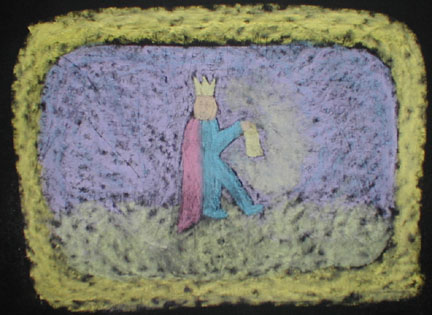
Since I wasn't having Kitty Bill draw in a lesson book, it didn't occur to me to guide him.  I wasn't even watching.  I didn't model anything for him to replicate.  I just said, "Why don't you draw something from today with the rainbow," and this is what he came up with.


The girls saw it first, and they were amazed.  How did he know to do it without lines?  How did he know to shape it?  How did he know to make the cape behind?  How did he get everything so perfect?

He shrugged his shoulders and told them that he had been watching them draw for a long time now.  As if it were that easy.

Each of them shared their hopes and dreams with me for learning and growing this year, and when I kissed each one of them goodnight, they all remarked at how excited they were for tomorrow.  It can't come soon enough.

I have a feeling this is going to be a really great year.

Thursday, August 23, 2012

Looking ahead


A few weeks ago I had a dream that Kitty Bill was in school, and he had brought home pages and pages of math homework.  It was so much work that it took him hours to complete it all.  There was even a page of long division!  No one in this house is focusing on long division at the moment, least of all Kitty Bill, so I don't know where that came from.  But then, he proudly took it to school the next day and his teacher couldn't even be bothered to check that he had done the problems correctly.  I marched in there, unmarked papers in hand, and demanded to know what the point was.  And his teacher responded that she simply hadn't the time nor the interest.  I was outraged, to say the least.

Luckily, my husband Einstein showed up in my dream just then to remind me that we're a homeschooling family.  Our ideals were still intact.  We will just educate Kitty Bill at home.  It will all be fine.  I woke up feeling a bit off-center, but grateful for the strange dream.  It didn't take much work to sleuth out the meaning of this dream: it's time.

Kitty Bill is a driven child.  He has been watching this homeschooling thing happen since he was a wee babe in my arms.  He knows the drill by now.  If I tell him a story, he thinks he should go draw a picture of it afterwards.  If he hears Moonshine practicing math facts, he makes up some for himself.  He actually walks around the house doubling numbers.  When he's sure that he's right, he'll come ask me, "Does seven and seven make fourteen?"

Computations aside, a few months ago he decided that he needed a dart board.  I don't even know where he got the idea of dart boards, but he was adamant that he needed one.  So he drew one on paper, and somehow, he managed to write numbers all around it - in order - all the way up to 39.  Some of the digits are backwards, but he appears to understand the concept well enough on his own.


He also started reading several months ago.  He asked to learn, and we showed him how to sound out the letters.  Everyone else in the house spends a lot of time reading, so I think he just wanted to know that he could do it, that the powers were within his grasp.  Once he mastered about thirty words he lost interest.  He still gets excited when he recognizes words in the world, but most of the time he would much rather draw pictures involving gears and mechanisms than anything else.  The more complexity involved in the drawing, the happier he seems to be.

For the most part, Kitty Bill has spent the last few years playing independently while I did lessons with the girls.  Homeschooling doesn't really have set hours at our house, so sometimes there is a bit of cross-over.  For example, a few months ago my discussion with Moonshine about equivalent fractions carried over into lunchtime.  When Einstein came home from work, Kitty Bill took it upon himself to explain equivalent fractions.  He's only six.  What does he know about equivalent fractions?  Apparently a lot.

And then, two weeks later, his teeth fell out.  Both bottom ones suddenly gave way.  New ones are already pushing up to fill the space.


He's ready.  He's so completely ready for Grade 1 work now that it's palpable.  I would argue, that despite his only recent change of teeth, he has probably been ready for a few months.  But I haven't been ready.  I've been holding on to my last baby-- basking in the final, lingering strands of his early childhood days.  They really are so fleeting.

While I don't always agree with the argument that children should be seven before starting school, in this case, that seems to be how it's working out.  Kitty Bill will be turning seven in September, and he's so ready for learning you can see the excitement dripping off of him.

It's exciting for me as well.  I'll be teaching three grades next year.  I know a few of my readers have already been teaching three or more children at home, and I am in awe of you.  This last year of homeschooling was so busy and full for us, I felt like I hardly had time to breathe between lessons, let alone scrub the toilet or blog as much as I would have liked.  I'm not sure how I'll manage to pull it all off this year, but I'm sure we'll find a new rhythm that allows it.  It always boils down to rhythm, doesn't it?
I would really like to get back into the rhythm of blogging more of our homeschooling, as well.  What I've shown on the blog only scrapes the surface of my work with these lively children.  I'm sure from the outside it looks like we're off gallivanting around the world every day-- and while I'll admit to trying to make the most of our time here in Europe, we actually spend the bulk of our time sitting around the kitchen table working together.
So it's time for me to begin again, at the beginning-- Grade One.  I'm looking ahead to the new school year, looking at the strange lists I've compiled of resources, and realizing that these lists really need to be updated-- badly! I made that first list almost eight years ago!  It has been that long since I first walked Sunburst along the path of the lovely alphabet story, and back then I was just starting out.  I didn't even know what a main lesson book looked like, let alone how to create one.  And there were only a handful of resources to choose from if you didn't have money for Live Ed (we didn't).  So those lists are really just bits I cobbled together while trying to figure it out.

Today there are scads of resources available to Waldorf-inspired homeschoolers.  You could read a new book each day of the year and still not get through them all-- not that anyone can adequately get through an entire Steiner lecture in one day, but you know what I mean.  The resources that have been coming out these last few years are astounding.  Homeschooling is getting easier every year, in that respect.  We still have to do the hard work of bringing it to our children in a meaningful way, but the bevy of instruction, insight, and inspiration is so much more available than it was a few years ago, especially for the lower grades.  Most of the things on my old lists pale in comparison to what's out there now.

My knowledge of Waldorf and Steiner has also grown and changed so much over the years.  I'm always learning something new, some nuance of the education that I didn't know before.  And I've noticed that when I get around to teaching a grade the second time, I realize what resources were really invaluable, and which ones I truly wasted my money on, or how I could have taught something differently or better. Now that I'm starting out homeschooling my third child, I hope to get to those resource lists and revise and update them very soon.

We're not planning to start lessons again until the week after next, so I'm using the next week to plan and dream while I let the last rays of summer wash over me.  Not many rays mind you-- I'm still in England-- but enough, I hope, to fill me with the fortitude I'll need to weather the changes in the coming months.  Change is always hard, whether it's a change of location or rhythm or simply just mindset.

I'm excited about another year of being able to watch and guide my children as they learn and grow. Though the work can be truly hard at times, it really is a gift.  I'm looking forward to sharing more of our journey with you, both the ups and the downs.  I even have a bit of an announcement coming up in the next couple of weeks, so I hope you'll stick around for that.

Have you started back to lessons with your children yet?  Or are you savoring the last days of summer (or winter, for my southern hemisphere friends)?  What changes await you this year?


Thursday, October 22, 2009

Math Gnome-li Love


Moonshine had a turn with the math gnomes recently, and she adores them.

While I was preparing to introduce the four processes, I went back to the same sources I used to prepare Sunburst's lesson so many years ago. But this time I was really appalled by what I read. In each one Plus is fat because he's greedy and Minus is kind of a numbskull. Somehow the force of this never bothered me before, but now, I'm presenting math to a melancholic/phlegmatic child who is neither greedy nor an idiot. And I certainly didn't want her to see those qualities in herself.

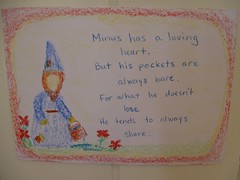
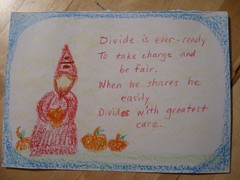
So this year I decided to do things differently. I decided to over-emphasize the POSITIVE traits of each temperament, er gnome. I wanted to let Moonshine know that although they each have different ways of working and being, they each have a heart of gold. --And she LOVES them! She immediately related to them and saw qualities of them inside herself.

Inspired by my friend Andrea's poems over at Littlest Birds, I also took Dorothy Harrer's poems and morphed them into my own, positive descriptions:


They hang on the wall near our workspace, and Moonshine loves to read them aloud. She also wrote two lines from each poem into her math book.


Gnome-li? The neighbor tells us that "Gnomli" is Swiss German for gnome. Kind of cute, huh? Don't forget to pronounce the G.

Monday, September 15, 2008

Different child, different story

Today I finally pulled it together enough to start Moonshine's first grade story. I say finally because she has been waiting and waiting patiently for it to begin. This is what first grade is about, she says. The story. The long, involved story that she witnessed Sunburst enjoying for her entire first grade year. Moonshine remembers Sunburst's story-- the key players, parts of the plot, and some of the adventures... for although she was but a three-year-old playing in the adjacent room, her ears and heart were finely tuned to the cadence of my voice.

From the start, it was apparent to me that I couldn't tell her the same story I told Sunburst. For so many reasons it is the wrong story for her-- the characters, while captivating, don't bring her the growth and empowerment that she needs. And most important of all, it would be like serving left-overs. Middle children have the feeling of getting enough leftovers as it is. And we just can't have that, can we?

It didn't feel easy this time. But with Einstein's help, I came up with a fairly captivating storyline last night. It mirrors the basic image of Sunburst's story-- there are three travelers setting out on a journey to save their kingdom, but it's a much more involved story. There are visions and wizards and bad dragons, red as blood. And that's just the beginning.

It's still a work in progress. The hard part is done though-- the characters, the plot... and now the adventure begins. I'm hoping for continued inspiration as we travel along with Eliza, the girl with the vision, her father Samuel, and little Gus, the wizard's (mostly) annoying nephew.

Moonshine can't wait to hear what happens next. And to be honest, neither can I.

Wednesday, August 27, 2008

And so we begin, again

Public school started here a couple of weeks ago, and despite my feelings of not readiness, we started back as well.

Moonshine lost her first two teeth this summer, and her excitement about doing some Real Work has been growing daily. She has been waiting for her turn, counting off the days with great anticipation. When our boxes finally arrived on the boat, she practically drooled while she watched me unpack her new tins of beeswax crayons, her Choroi pentatonic flute, and a stack of crisp main lesson books. She has been watching her older sister get to have "all the fun" for three years now, and as such, there aren't many secrets about what is in store for her. Rather, there is just this great longing and eagerness for what is rightfully hers.

One night as I was tucking her into bed, I mildly asked her if she wanted to start school tomorrow. No pomp, no circumstance, just one of those, "Well, shall we?"

She woke the next morning glowing with happiness. Today was the day. I hadn't planned it all out, to be quite honest, but since I had some circle songs up my sleeve and some basic forms in mind, I figured we'd make it work. After breakfast she lingered at the table looking at me with big eyes. "Shall we start?" I asked her.

She was pensive for a minute and then announced, "Well, I need a bridge. And a silk cape." Any doubts I had about her being more in this world than out of it, or her ability to pay attention, were unwarranted. She happily managed to put together her own sort of graduation ceremony, from the dreamy realm of Kindergarten into the solid earth of First Grade. A runner carpet became her makeshift bridge, and with big shining eyes, she began to walk. Sunburst, ever encouraging, joined me in song, and together we sang her across the bridge.

She was welcomed with hugs and kisses. I adorned her with a golden cape and presented her with the tools she will need on her exciting journey ahead-- one tin each of block and stick crayons. From the wide smile that spread across her face and the look of complete rapture in her eyes, this was better than Christmas and her birthday combined.

Moonshine is now a First Grader. For the past two weeks she has been jumping out of bed, regurgitating circle songs all day long, and practicing her new forms at every available opportunity. It was my birthday the other day, and for my present, she proudly presented me with one of the nicest complements any homeschooling mother could receive-- a stack of practiced form drawings, our latest form, that she had done secretly and quite obviously with great care, wrapped up gently in the golden, silk cape.

First grade. And so we begin, again.

Tuesday, June 19, 2007

Knitting Mania

Sunburst has been knitting for a long time-- since she was five. Her first project was a wobbly- looking scarf for her doll. Then she plowed straight into a matching hat, knit flat and sewn up the back. Since then I have let her knit with me, doing a stitch here and a row there, helping me on my projects as her enthusiasm warranted.

Enthusiasm has never been a problem with Sunburst. The girl likes to knit.

Her first grade knitting looked something like this:


She had been rereading the Little House series, and with all sincerity, wondered if Mary could knit blind. So she tied a silk around her head and tried. It amused me to no end to see her patiently sitting like this, feeling out the stitches with her fingers. Since she had just learned to knit with five double-pointed needles the blind-knitting show seemed risky, but she managed to knit a row or two this way.

After two weeks of persistence, she came up with a sock. Size small. Baby small.


She knit the heel flap, turned the heel, and felt really proud of herself. It was completely her idea to knit a sock. I wasn't sure she could pull it off, but when I mentioned that I had signed up for a knitting challenge and talked up my goal of knitting my first ever sweater, Sunburst decided that she should push her knitting to new heights as well. And besides, how hard could one little sock be? She had just watched me knitting my first pair or two.

That seems to be how her knitting projects get fueled. She sees me knitting something, and she wants to do it, too. And of course I can't say no to that. I can't deny knitting. And I don't want to tell her that she "can't"do something unless of course it's something dangerous or totally inappropriate. Knitting is hardly ever inappropriate.

So when I started knitting fruit and veggie hats this past fall, and Sunburst got the itch to make one, too... well, of course I took her to the store and let her pick out some yarn. She was determined to make a strawberry hat for a sweet, little baby friend in our homeschooling group.

It took her awhile, but she did it.


Not bad for a seven year old in second grade.

The great thing about knitting is that it's not instantaneous. It takes some time and dedication and focus. If there's one activity that really works on strengthening the will forces, this would be it. Knitting teaches you to keep moving forward-- one row at a time, one stitch at a time. Whatever it takes to get there. I've been working on a lace shawl since last summer (my first lace piece!) and slowly Sunburst has watched it grow at a painfully slow rate under my hands. And hopefully that rubs off on her. I think it does. Afterall, Sunburst did go back and knit another baby sock to make a matched set. Knitting that second sock can be excruciating... there are lots of knitters that succumb to "second-sock syndrome."

As for knitting as school work, I don't really care what Sunburst is knitting, as long as she's happy doing it. Her most recent works--in-progress include mittens, a scarf, and a teddy bear for the Mother Bear Project.

Wednesday, September 06, 2006

Modeling with Beeswax

This week I told the Grimm's story Allerleirauh, and it was great fun. We pulled out our Stockmar modeling beeswax and tried to capture the story in a different medium.

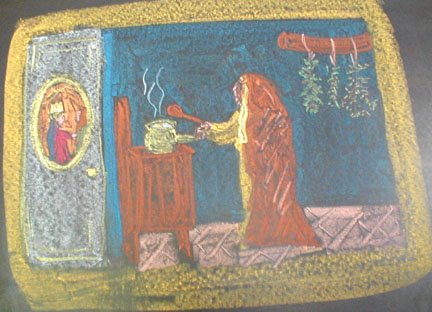
First I drew a representational picture on the chalkboard. Sunburst copied that picture into her main lesson book, and then pulled that image into her modeling. I didn't tell her what to make, I just let her lead the way. This is what she came up with:


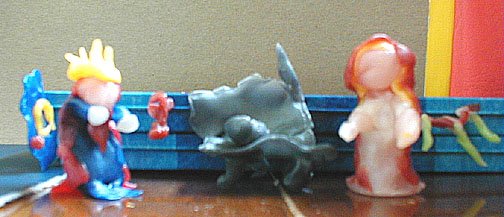
The King is on the left, and Allerleirauh is on the right. You can see her bright dress peeking out from her fur cloak. In the middle is the stove where Allerleirauh stirred the soup, and the brown bit is a spoon on a rack of some sort. Inside the pot of soup, which you can't see, is a golden ring. Behind the King is a door with a window. Behind Allerleirauh is a wooden bough with dried herbs for cooking.

She probably worked on this scene for 45 minutes or so. I sat next to her and sculpted my own vision of the characters on the left. What a large pot of soup I made! I tend to make enough food to feed an army in real life, so why should I be surprised that my modeling should turn out any different? The chalkboard scene we worked from is on the right.


To get started on your own modeling fun, I suggest you check out this PDF from Stockmar. Other manuals for their wonderful art products can be found HERE.

Monday, July 24, 2006

Teaching the Alphabet


In Waldorf education, the capital alphabet is taught one letter at a time using the medium of story and art to really bring the letters alive for each child in a memorable, meaningful way. The letters emerge out of the story, usually a Grimm’s Fairytale (but it doesn’t have to be,) and come to life on the chalkboard and page. For example, to introduce the letter M many people tell Simeli Mountain and draw a mountain that resembles an M.

While it’s not the quickest way to teach the alphabet, I found it to be the most rewarding. Not just for Sunburst, but for myself, as well. Every bit of it seemed important. The stories engaged our hearts. The artwork (drawing a story picture and letter) engaged our hands, and the learning of each letter awakened her thinking. That’s what the lesson is designed to do, but really it did even more than that. It awakened my creativity and belief in my ability to teach my own children. It deepened her respect for me as teacher and storyteller, and it awakened this magic world between us, steeped in goodness, beauty, and adventure.

There are many ways to go about this lesson. Some people just tell each letter story as a separate piece, and others weave a larger story that incorporates smaller stories for the letters. The idea of a larger story really appealed to me, but in my searching none of the complete stories I found really seemed to fit Sunburst’s needs and my own. If I was going to make a story come to life, it needed to work for my child and had to be engaging for me as well. In the end, I made one up.

I combined ideas from Path of Discovery Grade 1, Genii of Language by Alan Whitehead, Christopherus First Grade Syllabus, postings on various Waldorf e-groups by other homeschoolers, and mixed them with my own thoughts and what we were emoting based on our own personalities and the season (we started the lesson in late Fall.) It turned out to be a huge success in my house.

Seeing how others go about a lesson always helps kick my own creative gears into motion. It’s my hope that a glimpse into our story will do the same for others.

Here’s how it began:

* * *

Once upon a time there was a great kingdom with a brightly shining lantern, for all who lived there were happy and prosperous. The King of this land was kind and generous—he had a great castle and plenty of land and riches, but his greatest treasure by far was his only child, the Prince, whom he loved above all else.

Once day this King noticed that the light of the lantern was growing dim. He noticed the people of his kingdom were not as happy as before. Things just didn’t seem right. So he sent out his royal page to make inquiries around the kingdom, and the news he received was not good. Not only were the people of the kingdom unhappy and feeling lackluster,

1. The hens had stopped laying eggs.
2. The cows had stopped giving milk.
3. And even the grain had stopped flourishing in the fields.

So the kind and thoughtful King sat down and scratched his head and tried to fix the problem. He declared that the people should:

1. Feed the hens more food.
2. Pet the cows.
3. Water the grain.

Of course the good people of the kingdom followed his orders at once. The hens were given plenty of food. Children spent all day in the fields petting the cows, and the farmers watered and watered the grain. But it was to no avail. Nothing seemed to work, and everyone grew unhappier with each passing day, even the King himself.

Now it just so happened that there was a Wiseman who lived at the edge of this vast kingdom. He was quite old and wise and knew all about the healing ways of stones and plants, the ways of the stars and planets, and many, many stories of the land and its people. He was often called upon to solve the more difficult problems, sometimes at a moment’s notice, and so he kept on him always a blue satchel that he wore at his side—a place to put all things of importance and magic that would help him do his work.

The King, in his desperation, called upon the Wiseman for help. The Wiseman and his daughter Clara came to the royal castle in great haste, whereupon the King told him the details of the grand problem.

The King said, with a great sigh, “Our bright lantern is growing very dim. My people are unhappy, my family is unhappy, and I, myself, am unhappy, and yet I know not why. Furthermore, the hens have stopped laying eggs. The cows have stopped giving milk. And the grain no longer flourishes in the field.”

The Wiseman listened with great concern, and told the King he would be glad to try and help, but he would need three days to think the matter over. The King, having come to his wit’s end, quickly agreed.

On the first day, the Wiseman visited the hens. He spoke to them and asked them why they had stopped laying eggs, but they did not answer. On the second day the Wiseman spoke to the cows. He asked them why they had stopped giving milk, but they did not answer. And on the third day the Wiseman spoke to the grain. It was dry and brittle in the field. When it did not answer, the Wiseman plucked three pieces of grain and placed them in his satchel.

That night, the Wiseman took three smooth stones from his blue satchel and tossed them on the ground. He studied them carefully, and then reached back into his satchel for the three grains. He tossed those onto the stones and looked up into the night sky. Three stars shone brightly, and with a sudden flash, one of them shot across the sky, like a brilliant flame, leading West.

The Wiseman told the King, “The answer you seek lies outside of the kingdom. I must go on a quest, and I will take with me three things:

1. my wise daughter Clara
2. the kingdom’s lantern
3. the thing which you love the most (Prince)

Make the necessary preparations. We will leave in a fortnight.”

***

The characters set off on their quest to restore the light in the lantern, and thereby they would restore happiness and prosperity in the kingdom. But they didn’t know how they would do this, they sort of blindly set off on the wings of faith. That seemed to me to mirror the start of our formal educational process. In raising a child, or choosing to homeschool a child, you don’t get any guarantees that it’s going to work out. You have to rely on faith. For a child starting out on a formal path of learning, she can’t see the light at the end of the tunnel. She just knows she has to sit here and pay attention-- to have faith that something worthwhile will come of this.

As for the light in the lantern, well, we started this lesson late, around Martinmas. And restoring happiness and prosperity, restoring the light in the darkest time of the year, that’s a goal everyone can agree on and get behind. It was an unspoken something we could feel and relate to on the inside. This story took us through the bleak days of winter and culminated with the arrival of Spring, a return to happiness and prosperity.

On the journey, the specific tales emerged in direct relation to feelings and encounters, like the swan on the lake, the bear in the woods, or waiting for the heavy rains to let up. Sometimes the stories were told by people they met along the way, like the Queen and her jester, or Pirate Jack looking for buried treasure. Each of these people had their own stories to tell, as well, and it gave the greater story a sense of fullness.

We covered one to three letters a week. The map of our drawings and stories follows below.

W=Wiseman
K=King
J=Jug (Water of Life -Grimms)
P=Prince
~ O ~ (surprise)
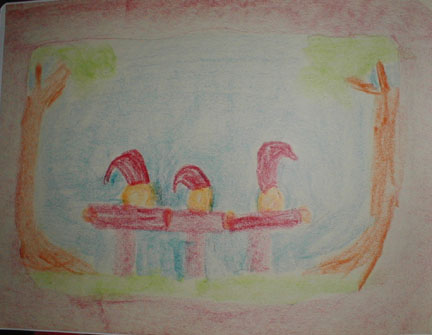
T=(Three Little Men in the Wood - Grimms)
M=Mountain (Simeli Mountain - Grimms)
D=Door in the mountain
~ E ~ (fear)
L=Lady
H=House (Mother Holle - Grimms)
N=Needle (The Spindle, the Shuttle, and the Needle - Grimms)
Q=(The Jolly Queen – own)
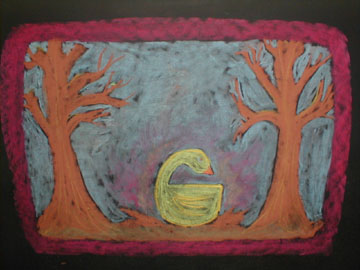
G=(The Golden Goose - Grimms)
C=Cave of Mysteries
----> Intro to Numbers ---->
V=Valley
Z=Zigzag of lightning
R=(Rapunzel - Grimms)
B=Bear (Masha and the Bear – Spindrift)
~ U ~ (concern)
S=Swan (Six Swans - Grimms)
~ A ~ (wonder)
X=X on treasure map (Pirate John - own)
F=(Fisherman and His Wife - Grimms)
Y=Yew tree (Birth of Christ)
~ I ~ (understanding of one's place in the world)

For the vowels I used the magical idea from Christopherus First Grade Syllabus of writing the letters on golden star paper from an art store. The vowels represented different feelings, and the Prince represented the kingdom. So when the Prince felt the fullness of these feelings along the way, in our story the stars fell from the sky. Each time a star fell, the light in the lantern would grow stronger. The Wiseman told the Prince to put the stars next to his heart, but at the end, when he reached into his pocket for the stars they weren’t physically there. There was only a happy warm feeling –they had become a part of him.

Sunburst pasted the stars into her book, which was great, except that the stars themselves posed a problem for any other drawings that would come next. We had to put an oil cloth between her pages to prevent an etching of the star to come through on the next several pages when she drew. Otherwise, it worked out great and seemed really magical.

At the end of our story, when the light shone as brightly as could be, our travelers hitched a ride back home on the back of a dragon they had met in the Cave of Mysteries when we segued into the Intro to Numbers.

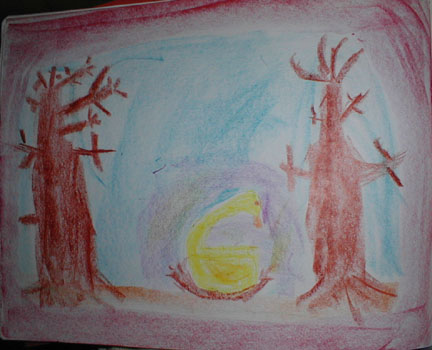
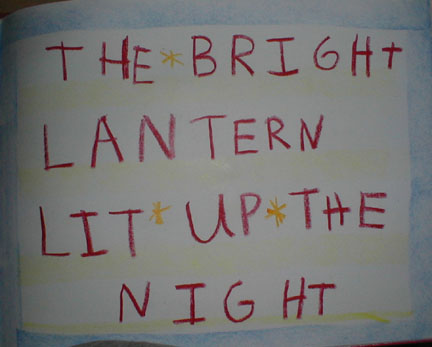
Sunburst wanted to fill up the end pages of her main lesson books (we filled TWO of them with our letter drawings,) and so we drew a few pictures and sentences that brought the story to a close.

Sunburst was sad to see the characters go. She deeply connected with Clara, so I resurrected her to travel along with us into our Maths lesson. That’s the great thing about homeschooling and making it up to suit your own child. When you find or create a story or character that really engages their heart you can take it with you into other lessons. It’s all about making it your own, making it work for you and your child.

Here are some examples of our work:

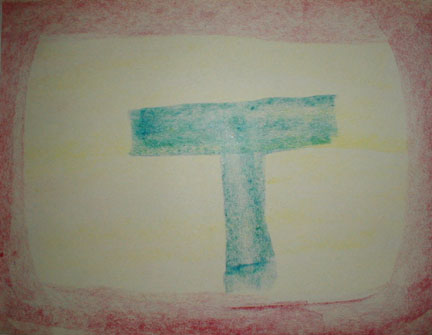
This one shows the progression from my chalkboard drawing (using crayola chalk), to Sunburst's rendition of it in beeswax crayon, and her drawing of the letter T.


I switched to Mercurius blackboard chalk partway through the lesson, and it made the chalk drawings appear much more intense and captivating.


The Cave of Mysteries was one of my favorite drawings. The orangeness was inspired by our visits to Southern Utah.


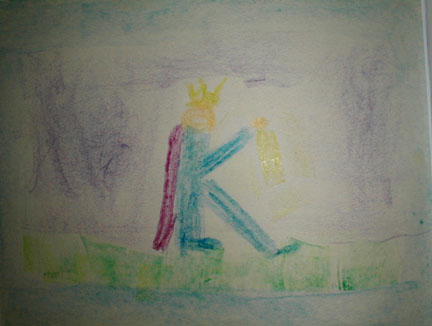
Here is the Wiseman for W, the King for K, an ancient Yew tree for Y, and a sample of a golden star/vowel pasted into the book.


I'm a sucker for happy endings.


We also made up fun little sentences for each letter and marched around the house repeating them ad nauseum. Here are a couple examples:

"Katie kindly kissed the king of kangaroos."
"Ten toads with twisted tounges drank tea in Timbuktu."

*For a great online list of Grimm’s Fairytales worth considering for your own First Grade lessons, check out David Darcy’s article.
Related Posts with Thumbnails
 
Site Meter